
When someone you love is dealing with anxiety, it can be hard to know what actually helps. Do you bring it up, or wait for them to talk? Do you push them to “just relax,” or let them work through it alone? Most families genuinely want to help but end up unsure of where the line is between support and overstepping.
The good news is that support doesn’t need to be complicated. Small, consistent things often matter more than grand gestures. Here’s what tends to help, and a few things that, despite good intentions, often don’t.
Start by Understanding What Anxiety Actually Feels Like
Anxiety isn’t just “worrying too much.” It can show up as a racing heart, restlessness, trouble sleeping, irritability, or a constant sense that something’s about to go wrong, even when nothing is. For many people, it’s exhausting in a very physical way, not just a mental one. Understanding this shifts the question from “why can’t they just calm down” to “what do they need right now.”
Listen Without Trying to Fix It Immediately
One of the most common instincts is to jump straight to solutions – “Have you tried meditation?” “Just don’t think about it.” While well-meaning, this can make someone feel unheard rather than supported. Often, people aren’t looking for a fix in the moment; they’re looking for someone to sit with them in it.
A simple response like “That sounds really hard; I’m here” does more than a list of suggestions ever will.
Avoid Minimizing Their Experience
Phrases like “it’s not a big deal” or “everyone gets nervous sometimes” usually come from a place of trying to reassure, but they can leave someone feeling dismissed. Anxiety isn’t about logic; telling someone their fear isn’t rational rarely makes it go away. What helps more is acknowledging the feeling is real, even if the trigger seems small from the outside.
Practical Things That Genuinely Help
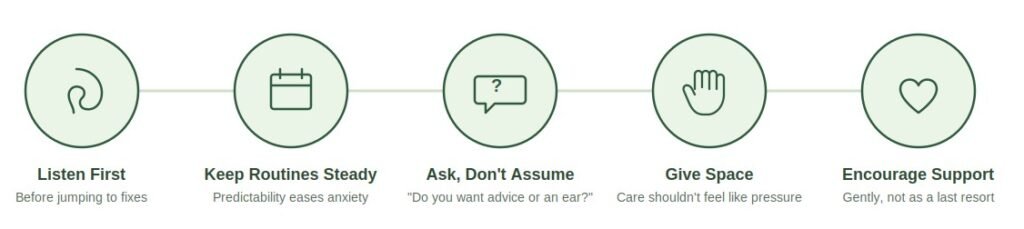
Beyond conversations, there are day-to-day ways families can ease the weight of anxiety:
- Keep routines predictable where possible; uncertainty often fuels anxiety
- Encourage small breaks during overwhelming moments, without making it a big deal
- Ask directly: “Do you want advice, or do you just want me to listen?”
- Avoid over-monitoring or constantly asking “are you okay?” – it can feel like pressure instead of care
- Support professional help gently, without framing it as a last resort
Watch Your Own Reactions Too
Anxiety in a loved one can make family members anxious themselves, trying to prevent every trigger, walking on eggshells, or feeling responsible for someone else’s calm. This usually isn’t sustainable, and it can unintentionally reinforce the idea that anxiety is something to be feared rather than managed. Families do best when they stay steady, rather than absorbing the anxiety as their own.
Say This, Not That
Sometimes it’s not about knowing the right psychology – it’s about knowing what actually to say in the moment. A few swaps that tend to land better:
- Instead of “Calm down” – try “I’m right here with you”
- Instead of “Why are you so worried about this?” – try “What’s on your mind right now?”
- Instead of “You’re overreacting” – try “This clearly feels like a lot”
- Instead of “It’ll be fine, don’t worry” – try “We’ll figure this out together”
None of these phrases fix anxiety on their own. But they signal something important, that the person isn’t alone in it, and that their reaction doesn’t need to be justified to be taken seriously.
Know When It's Time to Involve a Professional
Everyday support matters, but it isn’t a replacement for treatment when anxiety starts interfering with daily life – sleep, work, relationships, or physical health. Signs it may be time to seek professional guidance include:
- Anxiety that doesn’t ease even in calm periods
- Avoidance of everyday situations like work, school, or socializing
- Physical symptoms like chest tightness or panic attacks
- A noticeable withdrawal from people or activities they used to enjoy
Recognizing these signs early and gently encouraging professional support is one of the most meaningful things a family can do.
Supporting Each Other, One Day at a Time
There’s no single script for supporting someone with anxiety, and it’s normal to get it wrong sometimes. What matters most is consistency, patience, and a willingness to keep showing up, even on the harder days.
If anxiety has started affecting daily life for someone you love, professional guidance can make a real difference alongside the support you’re already giving at home. At Sunshine Wellness Centre, our team works with individuals and families across Mumbai to build personalized care plans grounded in both clinical expertise and genuine compassion.
If you’re not sure whether it’s time to reach out, that uncertainty alone is worth a conversation. Get in touch with Sunshine Wellness Centre to talk through what support could look like for your family.
About The Author